HW 4 - MOSFET Layout and Capacitances, NMOS Inverter-Dynamic Characteristics

4.1, 4.5-4.6: MOSFET Layout and Capacitances

4.2

We know that:

Cox″=ϵoxtox

thus, using ϵox=345fFcm−1:

Part Cox″
a =345fFcm−150nm=69.1nF⋅cm−2
b =138nF⋅cm−2
c =346nF⋅cm−2
d =691nF⋅cm−2

4.3

Using:

Cd=εSxd,xd≅2εSqNB(0.75V)

so using ε=103.545⋅10−14Fcm−1 and q=e=1.6⋅10−19C we get:

Cd≈1.051⋅10−8F=10.5nF

4.65

We know that:

Cox″=εoxtox,CGS=Cox″WL

where ε=345fFcm−1, so plug in our values of W=10μm and L=0.25μm:

Part tox Cox″ CGS
a 50nm 69nFcm−2 1.73fF
b 20nm 172.5nFcm−2 4.33fF
c 10nm 345nFcm−2 8.63fF
d 5nm 690nFcm−2 17.25fF

4.67

Use:

COL′=GGB=CGBOL=Cox″L

where since Cox″=εoxtox=345nFcm−2 then:

COL′≈17.3pFcm−1

4.70

We are given that Cox″=εoxtox=23nFcm−2, and CGSO=CGDO=20pF/m and the L=2Λ=1μm, and W=10Λ=5μm, so W=5⋅10−4cm and L=10−4cm.

a

For triode:

CGS=CGD=Cox″WL2+GGSOW=10.6fF

b

For saturation:

CGS=2/3⋅CGC+CGSOW=11.2fFCGD=GGDOW=10fF

c

For cutoff:

CGS=CGD=GGSOW=10fF

4.72

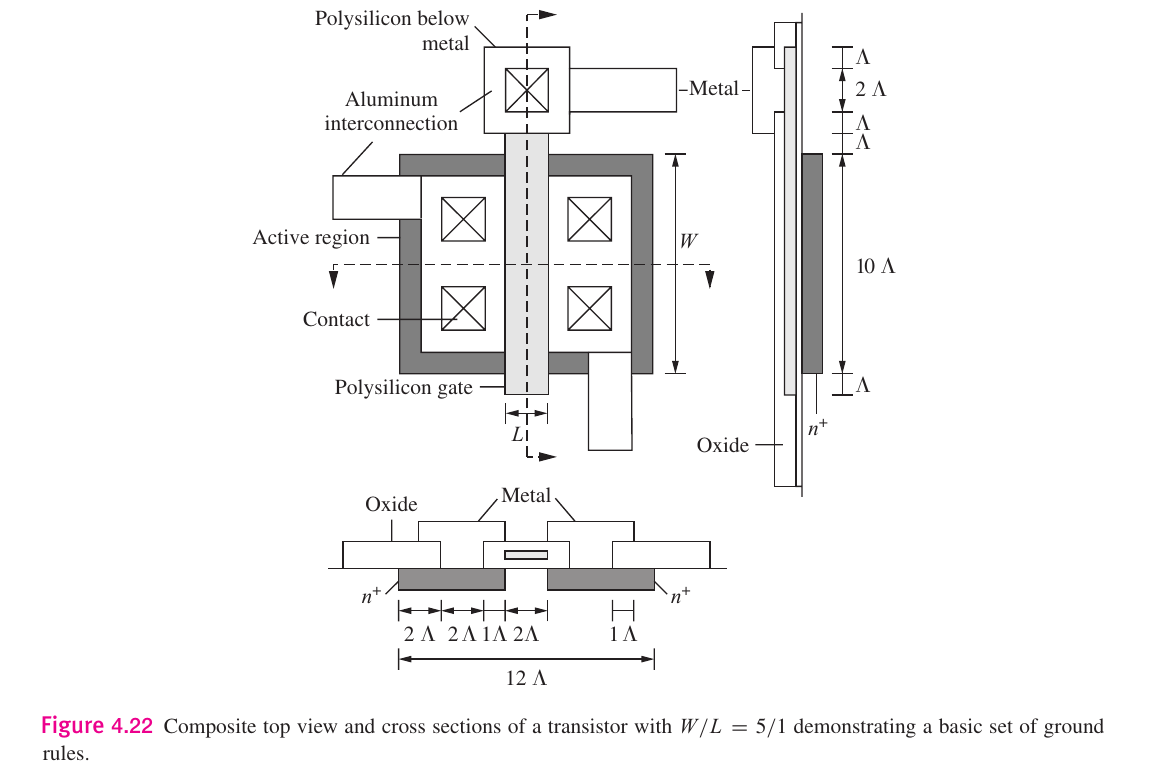
Consider the following:
Pasted image 20240206221129.png

If Λ=0.5μm then L=2Λ=1μm and W=10μm=5μm. We are also given that ND=1016cm−3, and NA=1020cm−3. We also have CJSW=CJ⋅5⋅10−4cm−1:

AS=5Λ⋅10Λ=125⋅10−9cm2=AD

via the symmetry of the diagram here AS=AD. Furthermore:

PS=10Λ+5Λ+5Λ+3Λ+3Λ+2Λ+2Λ=30Λ=15⋅10−4cm

We know from EE 306 that:

Xd0=2εSiϕoq⋅1NA+ND(NDNA+NAND)

plugging in values gives ϕo=VTln⁡(NANDni2)=0.935V:

Xd0≈34.8μm=0.0348mm=0.00348cm

so then:

Cj=εSiXd0=0.298nFcm−2

thus:

CSB=CJAs+CJSWPS=CJ(As+5⋅10−4cm−1⋅15⋅10−4cm)≈26.1fF

And by the symmetry of this problem, CSB=CDB=26.1fF.

6.11: NMOS Inverter-Dynamic Characteristics

6.136

We'll want to derive:
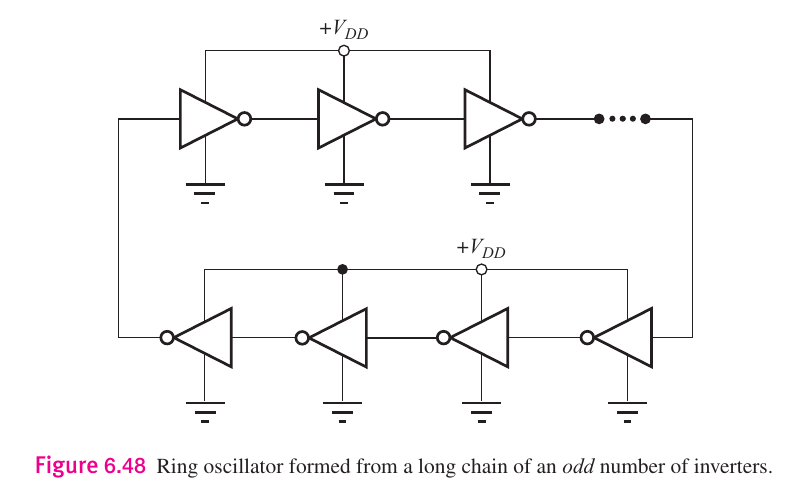
Pasted image 20240206222140.png

T=N(τPLH+τPHL)=2N⋅τP0

Adding the delays of each inverter from two round trips we get the result. For the first trip, since N is given and required to be odd, then we add:

T1=τPLH+τPHL+⋯+τPLH=N+12τPLH+N−12τPHL

For the second run we get the opposite order of delays, as we are flipped:

T2=τPHL+τPLH+⋯+τPHL=N−12τPLH+N+12τPHL

Adding them together:

T=T1+T2=N+12τPLH+N−12τPHL+N−12τPLH+N+12τPHL=NτPLH+NτPHL=N(τPLH+τPHL)=2N⋅τP0

6.139

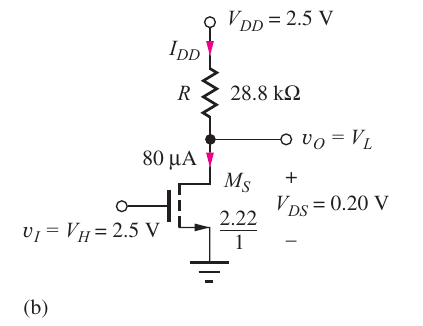
Given:
Pasted image 20240206222857.png

Given that we have a load of C=0.5pF. For a resistive load we use:

RonS=1Ks(VH−VtnS)=1100μA/V2⋅2.22⋅(2.5V−0.6V)≈2.37kΩ

Thus:

τPHL=1.2RonSC=1.42nsτPLH=0.69RC=9.94nstf=3.7RonSC=4.38nstr=2.2RC=31.69ns

Thus:

τP0=τPHL+τPLH2=5.68ns