HW 2 - NMOS Inverters (Resistor & Nonlinear Loads), PMOS Review

Chapter 6.5-6.6.3 (NMOS Inverters)

6.1

Consider 100,000 gates, with 1W on the entire chip.

a

We have:

Pgate,on=1W100,000=10μW

So average power is:

Pavg=1210μW=5μW

b

We know:

I=PV=5μW2.5V=2μA

6.2

Consider 100,000,000 gates, with 100W to dissipate:

a

Same as HW 2 - NMOS Inverters (Resistor & Nonlinear Loads), PMOS Review#6.1:

Pon=100W100,000,000=1μW

b

So then:

Pavg=0.25Pon=0.25μW

Calculate the current:

Iavg=PavgV=0.25μW2.5V=0.1μA

c

Just multiply the total number of gates by our current:

100,000,000⋅Iavg=10A

6.39

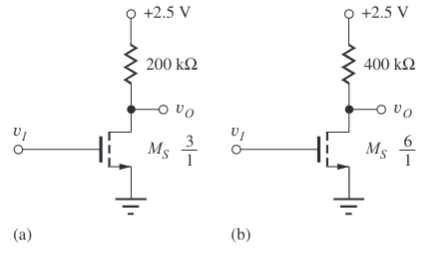
Consider the following, where VDD=2.5V:

Pasted image 20240122120532.png

We can use the table for values:

Kn′=100μA/V2,Vtn=0.6V

a

We know:

Kn=Kn′⋅3=300μA/V2

We know that Vo=VL so then VI=VH=2.5V. We know for these types that:

Vo=VDS=VDD−IDR=2.5−IDR

Since VGS−Vtn≥VDS then we are in Triode so then:

ID=Kn(VOV−VDS/2)VDS=Kn(2.5−Vtn−VL/2)VL

So then plug into our original equation and get:

VL=2.5−300μA/V2⋅200kΩ⋅(2.5−0.6−VL/2)VL

Giving:

VL=2.5−60/V(1.9−VL/2)VL=2.5−60(1.9VL−VL2/2)=2.5−114VL+30VL2⇒0=30VL2−115VL+2.5

So then we can solve and get VL=3.811V,0.022V so clearly VL=0.022V. We can get power dissipation by finding ID:

ID=12.5μA⇒P=IV=2.5V⋅12.5μA=31.3μW

b

We repeat (a):

Kn=6Kn′=600μA/V2VL=2.5−600μA/V2⋅400kΩ⋅(2.5−0.6−VL/2)VL

Thus:

VL=2.5−240/V2(1.9−VL/2)VL=2.5−456VL+120VL2⇒VL=0.00548V,3.803V

So clearly VL=5.48mV. Plug in as before:

ID=6.24μA⇒P=IV=2.5V⋅6.24μA=15.6μW

6.43

We as the noise margins for the circuit in HW 2 - NMOS Inverters (Resistor & Nonlinear Loads), PMOS Review#6.39.

a

VIL=1KnR+Vtn=1300μA/V2⋅200kΩ+0.6V=0.6167V

And:

VOH=VDD−12KnR=2.5−12⋅300μA/V2⋅200kΩ=2.4917V

And:

VIH=Vtn−1KnR+1.63VDDKnR=0.916V

And:

VOL=2VDD3KnR=0.167V

So then:

NML=VIL−VOL=0.456V

and:

NMH=VOH−VOL=1.5717V

b

We can repeat the same thing as (a), except that Kn=600μA/V2 and R=400kΩ are now changed using (b)'s values from before, giving:

VIL=

6.59

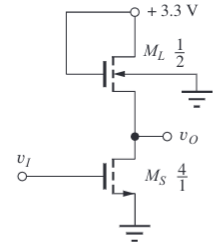
Pasted image 20240122130006.png

First, some calculations:

Kn,L=100μA/V2⋅0.5=500μA/V2,Kn,S=4Kn′=400μA/V2

Since γ=0 then:

VH=VDD−Vtn=3.3−0.6=2.7V

Solving for VL, we know that the currents are the same. ML is forced saturation, while MS is in triode when VI=VH=2.7V (since we know VI>>VO):

IL,sat=IS,triKn,L/2⋅(VGS,L−Vtn)2=Kn,S⋅VL(VH−Vtn−VL/2)25μA/V2⋅(3.3−VL−0.6)2=400μA/V2⋅VL(2.7−0.6−2.7/2)(2.7−VL)2=16VL(2.1−VL/2)VL2−5.4VL+7.29=33.6VL−8VLVL2−31VL+7.29=0VL=0.237V

Thus we can find ID=152μA so then P=500μW.

6.60

We just need to find Vtn and do the previous problem again. Notice:

Vtn=VTO+γ(VBS+2ϕF−2ϕF)=

Where VTO=0.6V, 2ϕF=0.6V:

Vtn=0.6+0.6(VH+0.6−0.6)

So:

VH=VDD−Vtn=3.3−0.6−0.6(VH+0.6−0.775)

Just plug in VH in a numeric solver to get:

VH=2.17V

Thus we do the same thing as prior, except with:

Vtn,sit=0.6+0.6(2VL+0.6−0.6)

Thus:

IDL=IDSKn,L/2⋅(VGS,L−Vtn)2=Kn,S⋅VL(VH−Vtn−VL/2)

Plug into a numeric solver and we get:

VL=0.256V

Chapter 4.3 (PMOS Review)

4.48

We know Kp′=μpCox″=μp⋅ϵoxtox, so since μp=200cm2Vs, and ϵox=345fFcm−1 for silicon oxide:

a) Kp′=200cm2Vs⋅345Fcm−150nm=13.8μAV2
b) Kp′=200cm2Vs⋅345Fcm−120nm=34.5μAV2
c) Kp′=200cm2Vs⋅345Fcm−110nm=69μAV2
d) Kp′=200cm2Vs⋅345Fcm−150nm=138μAV2

4.49

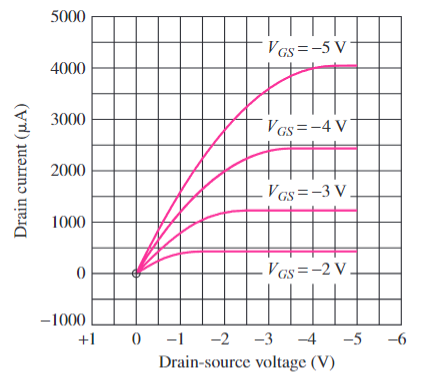
We are given:

Pasted image 20240123184522.png

We know that the pinchoff voltage is where the curve enters from triode into saturation. For say VGS=−5V⇒VSG=5V we see that it levels off starting at about VDS=−4.5V⇒VSD=4.5V, so then we have:

Vtp=−(VSG−VSD)=−(5−4.5)=−0.5V

Thus we can estimate the Kp value by plugging in a saturation value and using the corresponding drain current:

ISD=kp2(VSG−|Vtp|)2⇒1250μA=kp2(3V−0.5V)2⇒Kp=400μA/V2

Since we know that Kp′=40μA/V2 then W/L=KpKp′=10/1.

Typically enchancement MOSFETs turn "off" at voltages near 0, while depletion MOSFETs turn "off" at extreme voltages (high-low). In this case, the MOSFET turns "off" at a voltage of 0, so it is enhancement.

4.50

Recall that:

ID,sat=kp2(VSG−|Vtp|)2

At saturation ID stays relatively constant. We know what the values of Vtp and everything else are, so for VGS=−3.5,−4.5V we can see that:

ID,−3.5V=400μA/V22(3.5−0.5)2=1800μA/V2

and

ID,−4.5V=400μA/V22(4.5−0.5)2=3200μA/V2

Also, the voltage at which each becomes saturation is VDS=−3V and VDS=−4V respectively, which we use to plot the graph below:

4.51

We are given W/L=20 so then Kp=40μA/V2⋅20=800μA/V2. Since VBS=0V then Vtp=VTO=−0.75V.

a

We are given VGS=−1.1V and VDS=−0.2V, so then notice that first VGS<Vtp so we are not in cutoff, but furthermore:

0.2V=|VDS|≤|VGS−Vtp|=0.35V

So then we are in triode, so:

ID=800μA/V2(−1.1−(−0.75)−−0.22)(−0.2)=40μA

b

We are given VGS=−1.3V and VDS=−0.2V so then notice still VGS<Vtp but also:

0.2V=|VDS|≤|VGS−Vtp|=0.55V

So we are still in triode:

ID=800μA/V2(−1.3−(−0.75)−−0.22)(−0.2)=72μA

c

We do the exact same process as before, except now since VBS=1V then:

Vtp=VTO−γ(VBS+2ϕF−2ϕF)=−0.995V≈−1.0V

Thus for (a) we have VGS<Vtp and |VDS|≥|VGS−Vtp| so we are in saturation:

ID=400μA/V2(−1.1−(−1.0))2=4μA

and for (b) we have VGS<Vtp and |VDS|≤|VGS−Vtp| so we are in triode:

ID=800μA/V2(−1.3−(−1.0)−−0.22)(−0.2)=32μA

4.54

a

The on-resistance is given by:

Ron=1Kn(|VGS−Vtp|)

We are given that:

Kn=200⋅40μA/V2=8000μA/V2

Furthermore, we know VGS=−5V,Vtp=−0.75V, so |VGS−Vtp|=4.25V, thus:

Ron=18000μA/V2⋅4.25V=29.41Ω

b

If we repeat where VGS=5V and Vtn=0.75V for an NMOS transistor, we get the same exact finding since VGS−Vtn=4.25V, except now Kn=100μA/V2⋅200=20000μA/V2 so:

Ron=120000μA/V2⋅4.25V=11.76Ω

c

We require:

Ron=11.76Ω=140μA/V2⋅W/L⋅4.25V⇒W/L=500/1

4.57

The maximum on resistance comes from when VDS=0.1V (as small as it can be) while we consider it's current ID=0.5A, so then:

Ron,max=[∂ID∂VGS]−1|Q−pt=0.1V0.5A=0.2Ω

So then:

Ron≤0.2Ω⇒1Kn|VGS−Vtp|≤0.2Ω⇒Kp≥10.2Ω⋅|−10V−(−2V)|=0.625A/V2

is the maximum value for Kp.

4.59

Since VBS=4V then using our table values:

Vtp=VTO−γ(VBS+2ϕF−2ϕF)=−1.435V

So since −1.5V=VGS<Vtp we are not in cutoff. Further, |VDS|≥|VGS−Vtp| so we are in saturation. Using Kp=40μA/V2⋅25=1000μA/V2:

ID=500μA/V2⋅(−1.5V−(−1.435V))2=2.113μA

7.1

Note that:

Kn′=μn⋅Cox″=μn⋅eoxtox=500cm2/(Vs)⋅3.9⋅8.854⋅10−14F/cm100⋅10−8cm=172.7μAV2

And for Kp′ it's very similar:

Kp′=μp⋅3.9⋅ϵoxtox=200cm2/(Vs)⋅3.9⋅8.854⋅10−14F/cm100⋅10−10m⋅100cm/m=69.1μAV2