Chapter 6 (cont.) - Finishing Inner Product Spaces

We continue from the discussion of linear functions via Chapter 6 - Inner Product Spaces#^4afaec.

Linear Functionals on Inner Product Spaces

See our definitions of linear functional via 3.F in:

linear functional

A linear functional of vector space V is an element of L(V,F).

But notice that now inner products, over some constant v∈V can be formed via:

ϕ:V→F,ϕ(vin)=⟨vin,v⟩

where ϕ∈L(V,F). For example, consider φ:P2(R)→R given by:

φ(p)=∫−11p(t)(cos⁡(πt))dt

is a linear functional. But it is not obvious that for all p∈P2(R) that:

φ(p)=⟨p,u⟩

because notice that u=cos⁡(πt)∉P2(R).

Riesz Representation Theorem

Suppose V is finite-dimensional and φ is a linear functional on V. Then there is a unique vector u∈V such that:

φ(v)=⟨v,u⟩

for every v∈V.

\begin{proof}
First we show there exists a vector u∈V such that φ(v)=⟨v,u⟩ for every v∈V. Let e1,...,en be an orthonormal basis of V. Then:

φ(v)=φ(∑i=1n⟨v,ei⟩ei)=∑i=1n⟨v,ei⟩φ(ei)=⟨v,∑i=1nφ(ei)―ei⟩

Where the first equality comes from Chapter 6 - Inner Product Spaces#^ef9c3b. Thus, setting:

u=∑i=1nφ(ei)―ei

Then φ(v)=⟨v,u⟩ for every v∈V as desired.

Now we prove that only one vector u∈V has the desired behavior. Suppose u1,u2∈V are such that:

⟨v,u1⟩=⟨v,u2⟩=φ(v)

for every v∈V. Then:

0=⟨v,u1⟩−⟨v,u2⟩=⟨v,u1−u2⟩

for every v∈V. Taking v=u1−u2 shows that then u1−u2=0 so then u1=u2, showing uniqueness.
\end{proof}
As an example, let's find u∈P2(R) such that:

∫−11p(t)(cos⁡(πt))dt=∫−11p(t)u(t)dt

for all p∈P2(R). The way to do this is to let:

φ(p)=∫−11p(t)cos⁡(πt)dt

Where clearly φ is linear here. As such, then apply Chapter 6 (cont.) - Finishing Inner Product Spaces#^a857c6, by applying:

u=∑i=1nφ(ei)―ei

Thus then using the orthonormal basis from an earlier example:

u(x)=∑i=13φ(ei)―ei=(∫−1112cos⁡(πt)dt)12+(∫−1132tcos⁡(πt)dt)32x+(∫−11458(t2−1/3)cos⁡(πt)dt)458(x2−1/3)

where doing a bit of simplification shows that:

u(x)=−452π2(x2−1/3)

Notice that our formula for u is dependent on both our orthonormal basis e1,...,en as well as our chosen φ. However, by Chapter 6 (cont.) - Finishing Inner Product Spaces#^a857c6, then u is uniquely determined by φ, so the RHS of our definition of u is the same regardless of which orthonormal basis e1,...,en of V that is chosen.

6.C: Orthogonal Complements and Minimization Problems

orthogonal complement, U⊥

If U is a subset of V, then the orthogonal complement of U, denoted U⊥, is the set of all vectors in V that are orthogonal to every vector in U:

U⊥={v∈V:⟨v,u⟩=0∀u∈U}

For instance, if U is a line in R3 then U⊥ is the plane containing the origin that is perpendicular to U. If U is a plane in R3, then U⊥ is the line containing the origin that is perpendicular to U.

Basic properties of the orthogonal complement

  • If U is a subset of V, then U⊥ is a subspace of V
  • {0→}⊥=V
  • V⊥={0→}
  • If U is a subset of V, then U∩U⊥⊆{0→}
  • If U,W are subsets of V and U⊆W then W⊥⊆U⊥.

\begin{proof}
(a) Suppose U is a subset of V. Then ⟨0,u⟩=0 for every u∈U. So 0→∈U⊥. Suppose v,w∈U⊥. If u∈U then:

⟨v+w,u⟩=⟨v,u⟩+⟨v,w⟩=0+0=0

Thus v+w∈U⊥. If λ∈F then:

⟨λv,u⟩=λ⟨v,u⟩=λ0=0

Thus λv∈U⊥. Thus U⊥ is a subspace of V.

(b) Suppose v∈V. Then ⟨v,0⟩=0 implying that v∈{0→}⊥ so {0→}⊥=V.
(c) Suppose v∈V⊥. Then ⟨v,v⟩=0 so then v=0→ thus V⊥={0→}.
(d) Suppose U⊆V and v∈U∩U⊥. Then ⟨v,v⟩=0 so v=0→ so U∩U⊥⊆{0→}.
(e) Suppose U,W⊆V and U⊆W. Suppose v∈W⊥, then ⟨v,u⟩=0 for all u∈W. So ⟨v,u⟩=0 for all u∈U, so v∈U⊥ thus W⊥⊆U⊥.
\end{proof}
Recall that if U,W are subspaces then V is a direct sum V=U⊕W iff U∩W={0→}. In a similar manner:

Direct sum of a subspace and its orthogonal complement

Suppose U is a finite-dimensional subspace of V. Then:

V=U⊕U⊥

\begin{proof}
U is a subset of V, so then U∩U⊥⊆{0→}. Since 0→∈U,U⊥ then we have equality. Thus, if V=U+U⊥ then we are good. Notice that we can always do that because if v∈V then e1,...,em is an orthonormal basis of U:

v=∑i=1m⟨v,ei⟩ei⏟u+v−∑i=1m⟨v,ei⟩ei⏟w

choose u,w as defined above. Clearly u∈U since e1,...,em is an orthonormal list. For each j=1,...,m we have:

⟨w,ej⟩=⟨v,ej⟩−⟨v,ej⟩=0

so w is orthogonal to each vector in span(e1,...,em), so w∈U⊥. Thus v=u+w showing the sum V=U+U⊥.
\end{proof}

Dimension of the orthogonal complement

Suppose V is finite-dimensional and U is a subspace of V. Then:

dim(U⊥)=dim(V)−dim(U)

\begin{proof}
Apply Chapter 3 (cont.) - Products and Quotients of Vector Spaces#^5193d7.
\end{proof}

The orthogonal complement of the orthogonal complement

Suppose U is finite dimensional subspace of V. Then:

U=(U⊥)⊥

\begin{proof}
First we show (⊆). Suppose u∈U. Then ⟨u,v⟩=0 for every v∈U⊥. Because u is orthogonal to every vector in U⊥ then u∈(U⊥)⊥.

For the other direction, suppose v∈(U⊥)⊥. By Chapter 6 (cont.) - Finishing Inner Product Spaces#^8fdc3c, we can write v=u+w where u∈U and w∈U⊥. We have v−u=w∈U⊥. Because v∈(U⊥)⊥ and u∈(U⊥)⊥ (from using ⊆) then w=v−u∈(U⊥)⊥ by closure under v. addition. Thus w=v−u∈U⊥∩(U⊥)⊥, so then v−u is orthogonal to itself, so v−u=0→, so v=u so v∈U.
\end{proof}

orthogonal projection, PU

Suppose U is a finite-dimensional subspace of V. The orthogonal projection of V onto U is the operator PU∈L(V) defined as follows. For v∈V write v=u+w where u∈U and w∈U⊥. Then PUv=u.

PU is well defined since we can use Chapter 6 (cont.) - Finishing Inner Product Spaces#^8fdc3c.

Properties of the orthogonal projection PU

  • PU∈L(V)
  • PUu=u for all u∈U.
  • PUw=0 for all w∈U⊥.
  • range(PU)=U.
  • null(PU)=U⊥.
  • v−PUv∈U⊥
  • PU2=PU
  • ‖PUv‖≤‖v‖
  • For every orthonormal basis e1,...,em of U:
PUv=∑i=1m⟨v,ei⟩ei

\begin{proof}
The proof of these is very easy to do, and is found in 2015_Book_LinearAlgebraDoneRight#page=197.
\end{proof}

Minimization Problems

The following problem is really common: given a subspace U of V and a point v∈V, find a point u∈U such that ‖v−u‖ is as small as possible. The next lemma shows that this problem is solved by taking u=PUv.

Minimizing the distance to a subspace

Suppose U is a finite-dimensional subspace of V, v∈V and u∈U. Then:

‖v−PUv‖≤‖v−u‖

Furthermore the inequality above is an equality iff u=PUv.

\begin{proof}

‖v−PUv‖2≤‖v−PUv‖2+‖PUv−u‖2(0≤‖PUv−u‖2)=‖(v−PUv)+(PUv−u)‖2Pythagorean Theorem=‖v−u‖2

Here we only get equality if the top line is an equality, iff ‖PUv−u‖=0 iff u=PUv.
\end{proof}
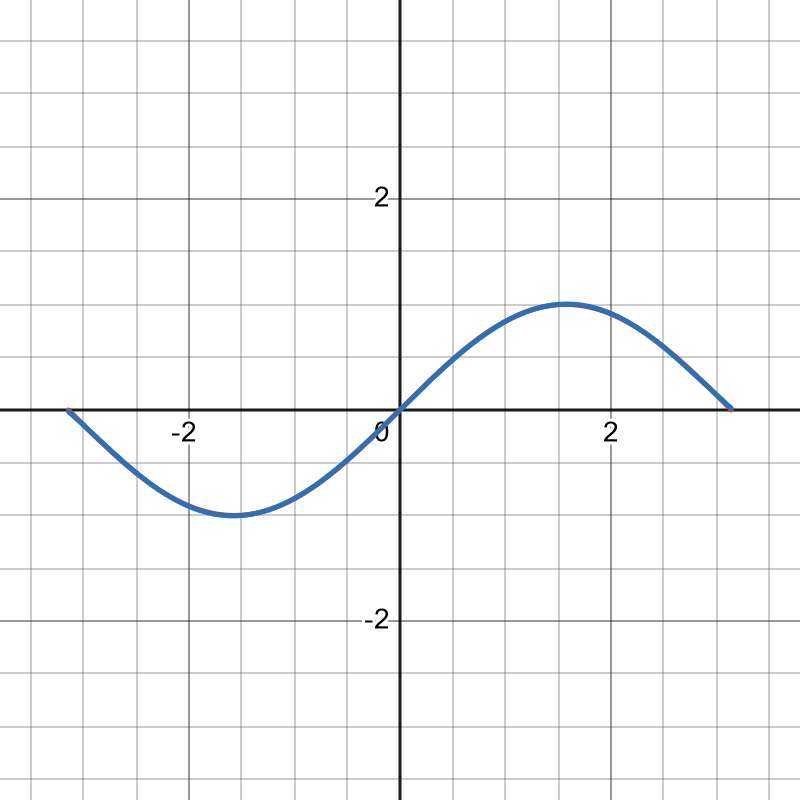
Let's do a cool example! Let's find a polynomial u with real coefficients and degree at most 5 that approximates sin⁡(x) as well as possible on the interval [−π,π] in the sense that:

∫−ππ|sin⁡(x)−u(x)|2dx

is as small as possible. We'll compare to the Taylor Series approximation. Let CR[−π,π] denote the real inner product space of continuous real-valued functions on [−π,π] with inner product:

∫−ππf(x)g(x)dx

Let v∈CR[−π,π] be the function defined by v(x)=sin⁡(x). Let U denote the subspace of CR[−π,π] consisting of the polynomials with real coefficients and degree at most 5. Our problem can be reformulated as:

Find u∈U such that ‖v−u‖ is as small as possible.

To compute this, apply Gram-Schmidt via Chapter 6 - Inner Product Spaces#^d43651 to the basis βs={1,x,x2,x3,x4,x5} of U, producing an orthonormal basis e1,...,e6 of U. Then, again using the inner product given by the Gram-Schmidt Procedure, compute PUv using Chapter 6 (cont.) - Finishing Inner Product Spaces#^3861ef part (i), where for every orthonormal basis and using m=6 in this case:

PUv=∑i=16⟨v,ei⟩ei

doing this here shows that PUv is the function u defined by:

u(x)=0.987862x−0.155271x3+0.00564312x5

as a close approximation. And to see how good it is, check it out:

desmos-graph(1).png

Can you see the red sine wave? That's sin⁡(x)! That's right, this sine wave is really well approximated by the blue u(x) curve.

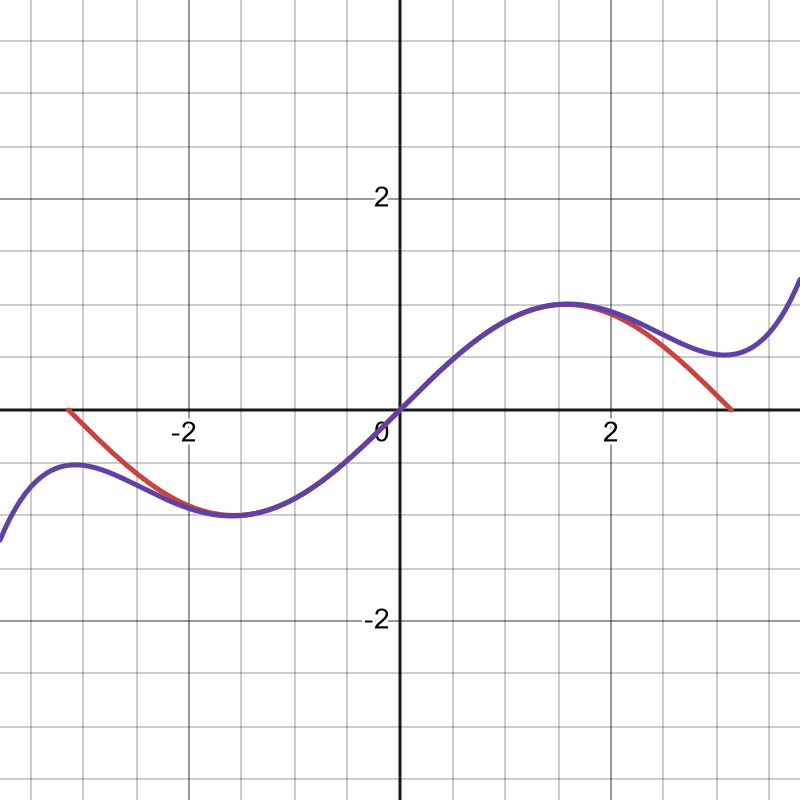
Compare that with the 5-th degree Taylor polynomial over the same interval

desmos-graph(2).png

Look at how much better this approximation is! That's because taylor polynomials really are only good near |x|<2. Other than that, they start to really suck.